
DATA & AI

AI AGENT GOVERNANCE: HOW TO DEPLOY AGENTIC AI SECURELY AND AT SCALE

Published : 3/11/2026

Nuria Sánchez Almodóvar - AI Director Iberia Latam at Inetum
Mikel Urizar Zapata - Generative AI Center of Excellence Manager Iberia Latam at Inetum


The rise of agentic AI is creating a new challenge for organizations: how to scale autonomous systems without losing control. Unlike traditional generative AI solutions that primarily generate content or answer questions, AI agents can make decisions, execute actions, interact with enterprise systems, and coordinate complex workflows independently.


Test

WHY AGENTIC AI CREATES A NEW GOVERNANCE CHALLENGE

Agentic AI represents the next evolution of generative artificial intelligence. Unlike conventional AI systems that respond to prompts, AI agents can take actions to achieve predefined objectives.

These systems can:

  • Use enterprise applications and tools.
  • Execute multi-step reasoning and decision-making processes.
  • Maintain persistent memory.
  • Interact with multiple systems and data sources.
  • Automate tasks that previously required continuous human supervision.

This level of autonomy creates significant opportunities for productivity, efficiency, and business transformation. It also introduces governance risks that organizations must address before deployment at scale.
 

For business and technology leaders, the challenge is no longer simply building more capable AI systems. It is ensuring that AI agent governance, security, traceability, and compliance are embedded into deployment from day one. As organizations move from pilots to production environments, governance is becoming a critical requirement for sustainable AI adoption.

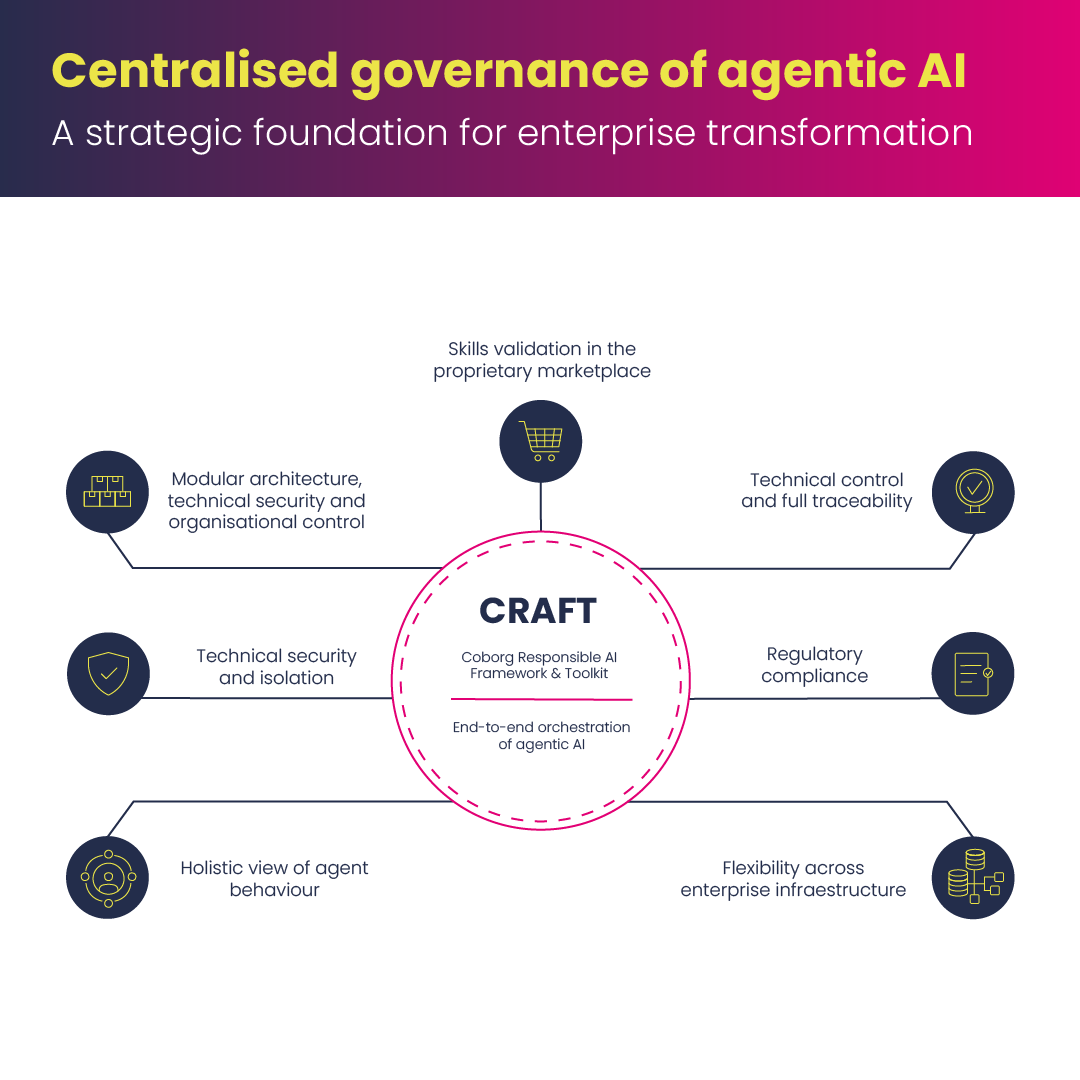
In this context, Inetum has developed CRAFT (Coborg Responsible AI Framework & Toolkit), an AI orchestration platform designed to enable the secure deployment, governance, and operation of AI agents through modular architecture, organizational controls, and advanced traceability capabilities..

The emerging risks of autonomous AI agents

As AI agents gain greater autonomy, organizations need stronger governance frameworks and control mechanisms.

Key challenges include:

  • Unauthorized access to business systems or sensitive information.
  • Execution errors affecting critical processes.
  • Biased or difficult-to-explain decisions.
  • Dependence on unverified third-party tools.
  • Limited visibility into decision-making processes.
  • Difficulties demonstrating regulatory compliance during audits.

For this reason, AI governance should be considered a foundational component of agentic AI architecture rather than an additional layer implemented later.

Why AI agent governance accelerates enterprise adoption

AI governance is often viewed as a compliance exercise. In practice, it is much more than that.

A robust governance framework helps organizations build trust, reduce operational risk, and accelerate the adoption of AI across the enterprise.

Effective governance for AI agents requires two complementary dimensions:

  • A technical dimension focused on security, observability, traceability, and execution control.
  • An organizational and regulatory dimension focused on risk management, oversight, and compliance.

CRAFT combines both perspectives within a unified platform, helping organizations bridge the gap between AI innovation and the regulatory requirements shaping the European AI landscape.


Traceability: the foundation of governable AI systems

One of the most important requirements for governing AI agents is understanding what they do, how they do it, and why they make specific decisions.

AI traceability is no longer just a technical capability. It has become a fundamental requirement for AI risk management.

When autonomous agents operate in critical business processes, organizations need visibility into:

  • Actions executed.
  • Tools invoked.
  • Data consulted and generated.
  • Decision pathways.
  • Final outcomes.

To address this challenge, CRAFT records the complete lifecycle of agent activities, providing end-to-end observability and enabling real-time monitoring, auditability, and explainability.

This level of transparency helps organizations detect deviations, investigate incidents, and demonstrate compliance more effectively.

Modular architecture and isolated execution environments

CRAFT is built on a modular and extensible architecture that allows organizations to replace, extend, or restrict components without disrupting the overall solution.

This modularity increases technology flexibility while strengthening governance controls, since every integration can be validated before entering the operational ecosystem.

The platform also incorporates isolated execution environments where access to tools and resources is tightly controlled.

This approach:

  • Reduces attack surfaces.
  • Limits exposure to security threats.
  • Protects production systems.
  • Preserves data integrity and confidentiality.

As a result, organizations can increase AI autonomy while maintaining enterprise-grade security.

Governing AI agent capabilities through a Skill Marketplace

AI governance and regulatory compliance in the era of the AI Act

The growth of open standards such as the Model Context Protocol (MCP) is accelerating the development of AI agent ecosystems.

These ecosystems rely on specialized capabilities, often referred to as skills, which allow agents to interact with business applications, external platforms, and data sources.

While this model promotes innovation, it also introduces potential security, quality, and compliance concerns.

To address these challenges, CRAFT includes a Skill Marketplace, where every skill is evaluated before deployment.

The assessment process includes:

  • Technical security.
  • Operational reliability.
  • Alignment with corporate policies.
  • Regulatory compliance.
  • Compatibility with governance requirements.

Each skill operates within controlled environments, reducing exposure to third-party vulnerabilities and limiting unexpected behaviors.

This balance between innovation and control is essential for  enterprise-scale adoption of agentic AI.

The European Union AI Act is the world's first comprehensive regulatory framework governing the development, deployment, and use of artificial intelligence systems.

The regulation introduces new obligations for high-risk AI systems, including:

  • Decision logging and documentation.
  • Risk assessment and mitigation.
  • Human oversight mechanisms.
  • Traceability controls.
  • Enhanced security measures.
  • Lifecycle management processes.

Organizations should not view governance solely as a legal requirement.

Increasingly, governance is becoming an operational requirement for scaling AI initiatives beyond isolated experiments and into sustainable enterprise operating models.

Platforms such as CRAFT integrate governance controls directly into the technology architecture, supporting centralized oversight, agent auditing, risk management, and end-to-end traceability.                            This approach is particularly valuable in highly regulated sectors such as public administration, banking, insurance, energy, and healthcare.

AI GOVERNANCE AND REGULATORY COMPLIANCE IN THE ERA OF THE AI ACT

The European Union AI Act is the world's first comprehensive regulatory framework governing the development, deployment, and use of artificial intelligence systems.

The regulation introduces new obligations for high-risk AI systems, including:

  • Decision logging and documentation.
  • Risk assessment and mitigation.
  • Human oversight mechanisms.
  • Traceability controls.
  • Enhanced security measures.
  • Lifecycle management processes.

Organizations should not view governance solely as a legal requirement.

Increasingly, governance is becoming an operational requirement for scaling AI initiatives beyond isolated experiments and into sustainable enterprise operating models.

Platforms such as CRAFT integrate governance controls directly into the technology architecture, supporting centralized oversight, agent auditing, risk management, and end-to-end traceability. This approach is particularly valuable in highly regulated sectors such as public administration, banking, insurance, energy, and healthcare.

Diagram showing CRAFT, the Coborg Responsible AI Framework & Toolkit, at the centre of agentic AI governance, connecting modular architecture, technical security and isolation, skills validation, technical control and traceability, regulatory compliance, infrastructure flexibility, and holistic monitoring of agent behaviour.

A holistic approach to responsible AI

Responsible AI governance extends far beyond security and compliance.

Organizations should continuously assess:

  • Data privacy and protection.
  • Algorithmic fairness and bias.
  • Quality and reliability of generated outputs.
  • Energy consumption.
  • Operational costs.
  • Efficient use of computational resources and tokens.
  • Impact on users and business processes.

Taking a holistic approach helps ensure that AI systems align with technical, regulatory, ethical, and business objectives.


Building a scalable future for agentic AI

Adoption of AI agents is accelerating across industries. The real challenge is no longer creating more intelligent systems. It is ensuring that those systems can operate safely, transparently, and sustainably at scale.

Trust in AI is built through governance. Organizations need mechanisms for control, auditability, traceability, and compliance that allow autonomous systems to operate reliably in production environments.

As agentic AI becomes increasingly embedded in enterprise operations, governance will be one of the key enablers of long-term success. Platforms such as CRAFT are helping organizations establish the operational foundations needed to deploy, govern, and scale AI agents in a rapidly evolving regulatory and technological landscape.


Do you have the visibility and controls needed to manage AI agents across your organization?

Discover how Inetum helps organizations establish governance frameworks that provide transparency, accountability, and control throughout the AI lifecycle.