

Sales Cloud: Welcome the Number One CRM and Claude to Your Team
Deep Dive: Revenue and Platform
The EVP of Sales Cloud introduced a new revenue formula: truth, context, action. Customers on this playbook see a 30% increase in revenue growth and two to ten times seller productivity. Devolutions grew revenue by 80% and doubled account executive's deal volume.
Momentum, a conversation-intelligence layer, listens to live calls and writes directly into Salesforce. Zscaler, a two-year customer, cut proposal planning from six to eight hours down to under 30 minutes, a 20-times improvement. On outbound, the new agent Hunter independently studied 1,500 plus call recordings, and 10,000 plus emails to learn how a business sells, then prioritized accounts accordingly. Batteries Plus, a 700 store franchise, used agents to build $18 million in commercial pipelines since Q1.
The headline was Sales Cloud and Claude going into production with 37 sales skills at launch. In a live demo, a Salesforce revenue leader built a full sales command center from a single prompt, no configuration, and instantly surfaced which deals had slipped and why.
Agentforce: From Fast Start to Real ROI
Fulton Bank deployed Agentforce Coworker in one hour and reached 3,000 employees within six weeks, saving 80,000 hours and generating over $389 million in new loans and deposits. Southwest Airlines used AgentScript to automate a name-change process requested 25,000 times a month, and its customer AI assistant now engages over 20,000 customers with CSAT above 60%.
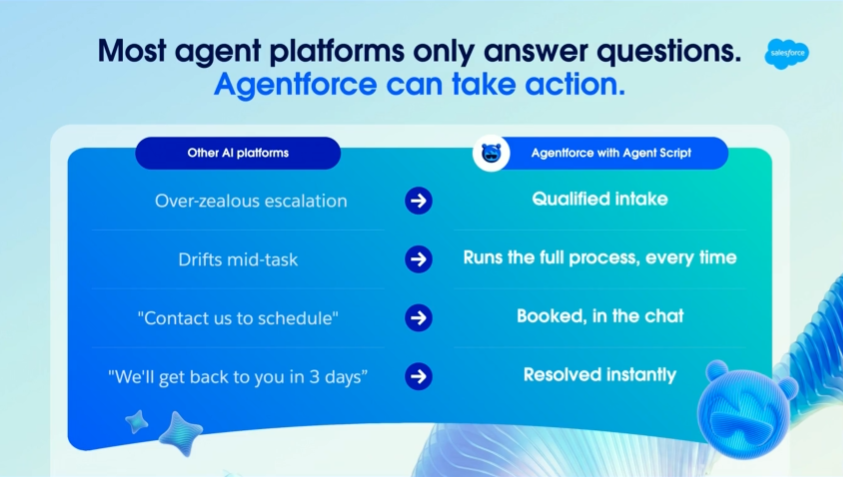
Vivint scaled its Ava voice agent to nearly 2.5 million customers with no added headcount, aided by Agentforce Observability, now unmetered and free. The keynote's biggest reveal was Agent Optimizer, an agent that finds underperforming patterns, drafts and tests a fix, and rolls it out gradually, on its own.
At Inetum, the deploy-customize-optimize sequence is the exact delivery discipline behind Inetum's 25-plus Agentforce production deployments, and Agent Optimizer materially shortens the specialist hours the "optimize" phase usually demands.
Data 360: Context Is Your AI Advantage
A blunt thesis opened the keynote: more data will not save you, and a smarter model will not either. What converts AI into business outcomes is trusted enterprise context. Salesforce reported 200% growth in Data 360 over the past year and 263 trillion rows now under management; 70% of it accessed through zero-copy connections rather than data movement. FedEx cited a 2,000% ROI on its Data 360 investment; Windom saw 300 basis points of better conversion and a 15% lift in daily rates once its engagement data carried the right context.
At Inetum, Data 360, alongside Informatica, MuleSoft, and Tableau, is the foundation every Inetum Agentforce engagement is sequenced around. This session's numbers are the clearest evidence yet that the sequencing, not just the agent, drives the ROI.
Revenue Cloud: Beyond CPQ: One Engine, Every Experience
Revenue Cloud reported the customer base has grown over 300% in twelve months, with 80 million quotes processed on the platform. A built-in-headless architecture now delivers 40% faster quote creation, and a Claude-governed pricing demo showed the deterministic rules engine catching and correcting an out-of-policy discount in real time, probabilistic reasoning paired with rules that cannot be talked out of the guardrails.
Service Cloud: Drive Outcomes at Every Customer Touchpoint
GM of Agentforce and Service Cloud, introduced Casey, an out-of-the-box help agent now priced on outcome, customers pay only on resolution, with unlimited Data 360 queries and Agentforce actions included. Salesforce reported a platform-wide 33% improvement in customer satisfaction and a 28% reduction in cost.
Deep Dive: Industry Keynotes
Financial Services: Your Pilot-to-Profit Playbook
Consumer trust in AI for financial advice has jumped from one in ten Americans to five in ten in a single year, a 400% increase, against an $84 trillion generational wealth transfer already underway. Bank of America's CIO described an AI assistant with 3 billion cumulative interactions and a new "journey of a meeting" capability, deployed to 35,000 bankers and advisors, saving up to four hours per relationship manager across a million meetings a year.
Rocket Pro rebuilt a decade-old Salesforce instance before layering on Agentforce, then ran an AE-facing Slack integration that let its sales team work entirely off mobile devices at a live event
Manufacturing: Building an Agentic Future Together
PPG described six consecutive quarters of positive organic sales growth after standardizing 10,000 sellers across 32 legacy ERP systems onto one CRM, following 50 acquisitions. Komatsu's guided troubleshooting agent puts service manuals and case history directly in technicians' hands in the field, addressing an aging, retiring workforce.
Government: Scale Mission Impact with Trusted AI
Thames Valley and Hampshire Police cut average call wait times from 30 minutes to under 3 using their agent, Bobby, handling 1.3 to 1.4 million contacts a year, 70% now self-served, with 163,000 fewer human-handled contacts and satisfaction up 15%.
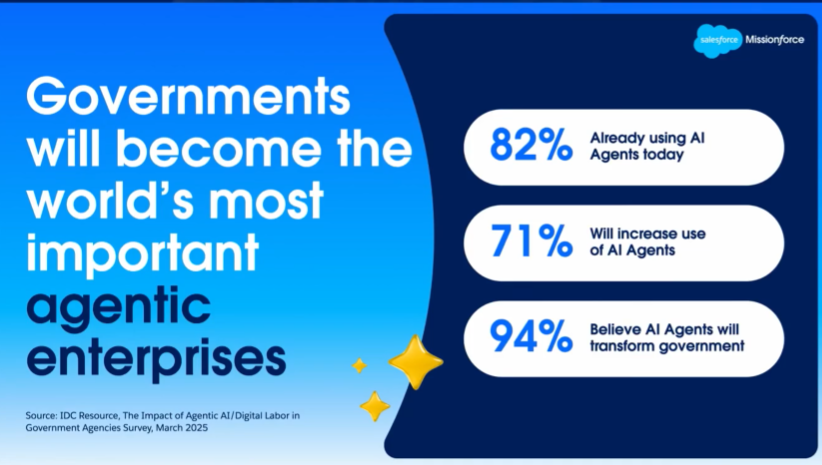
Agentforce is now FedRAMP High certified and DOD IL-5 compliant, the U.S. Army's Human Resources Command became the first Department of Defense agency to deploy it, connecting a decades-old mainframe through MuleSoft.
Consumer Goods: Discover the Unified Commercial Hub
Mars reported six-consecutive-quarter progress on its "One Demand" transformation, with its internal growth team building over 4,000 agents since launch. L'Oréal has deployed Agentforce across 25 of its 40 brands, cutting case-handling time by 64%, while Nestlé rolled agents out to a new market in as little as two weeks across 2,000 brands and 185 countries, reaching a 4.8 out of 5 CSAT score.
What This Means for Enterprise Leaders
For CIOs, Dreamforce 2026 reinforced a clear message: competitive advantage no longer comes from access to AI models, but from connecting trusted data, business processes, and governance into a scalable AI operating model. The organizations seeing the strongest results are those building context-rich architectures, not simply deploying more AI.
For Sales & Marketing Leaders, the next wave of productivity will come from AI embedded directly into CRM workflows. As shown across Sales Cloud, Agentforce, and Revenue Cloud, leading organizations are using AI to identify opportunities, prioritize accounts, and accelerate decisions inside the sales process itself, driving measurable revenue impact.
For Operations Leaders, deploying agents is only the beginning. Long-term value depends on governance, observability, and continuous optimization. Just as DevOps became essential in the cloud era, managing and improving AI agents is rapidly becoming a core operational discipline for enterprise organizations.
Day Two: Top 3 Dreamforce 2026 Takeaways
Three things stood out across an unusually dense day:
1. Context and not the model, is the moat. Whether the session was Data 360, Sales Cloud, or the Financial Services keynote, every customer citing measurable lift did so by grounding AI in enterprise context first.
2. The three-step playbook repeats at every scale. Deploy fast, customize with the platform's own tools, then observe and optimize.
3. Governance is now a revenue conversation, not just a security one. Agent Fabric, Revenue Cloud's deterministic guardrails, and outcome-based pricing all point in the same direction: enterprises are being asked to pay for, and govern, what agents resolve.
Dreamforce Day Two confirmed that the AI race is no longer about building smarter models. It is about building smarter enterprises. Organizations that combine trusted data, AI agents, and continuous optimization are already turning AI into measurable business outcomes and competitive advantages.
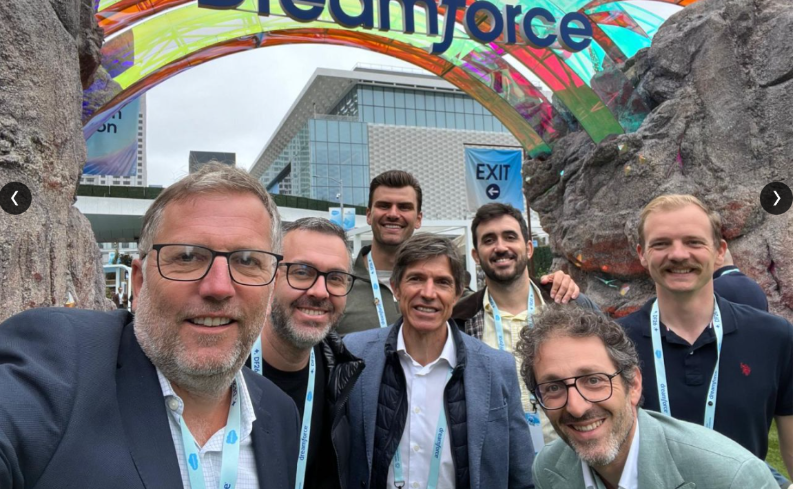
The Inetum team is at Dreamforce 2026 all week, on the ground in San Francisco tracking every announcement and bringing the insights back to our clients across Europe.